PPOAF COMMENDS ADVANCEMENT OF AFRICA’S SPACE AGENDA AT THE 4TH ADIGUN ADE ABIODUN MEMORIAL LECTURE
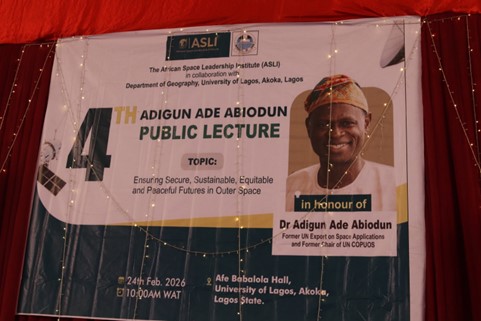
Professor Peter Olufemi Adeniyi Foundation (PPOAF) has applauded stakeholders across academia, policy, and industry for renewing calls for deliberate, coordinated, and long-term investment in Africa’s space science and technology capacity. The call was reinforced at the 4th Adigun Ade Abiodun Memorial and Public Lecture, held at the Afe Babalola Auditorium, University of Lagos on 24th February, 2026.

The 2026 edition marked one year since the transition of the distinguished space statesman, Adigun Ade Abiodun, whose lifelong work advanced remote sensing, space policy, and institutional development across Africa. Established in his honour, the annual lecture continues to deepen knowledge of space science while promoting dialogue on governance, sustainability, security, and equitable access to space resources.
The event was hosted by African Space Leadership Institute (ASLI), in collaboration with the Department of Geography, University of Lagos, bringing together policymakers, defence officials, scholars, and students in a shared commitment to Africa’s strategic participation in the global space ecosystem.
The Chairman of the Occasion, Emeritus Professor Peter Olufemi Adeniyi, OON, described the memorial lecture as both an intellectual tribute and a strategic platform for continental advancement. Reflecting on over four decades of professional association with the late scientist, he emphasized that Africa’s development trajectory is increasingly tied to mastery of space science and geospatial intelligence.

He noted that space technology has moved from aspiration to necessity, now underpinning critical sectors including agriculture, environmental management, urban planning, disaster response, infrastructure development, communication and national security. Calling for a “symphony of disciplines,” he urged scholars and practitioners to break academic silos and align scientific innovation with policy implementation for measurable impact.
Representing the Vice-Chancellor of the University, Professor Folasade T. Ogunsola, OON, FAS, the Dean of the Faculty of Social Sciences, Professor Adelaja Odukoya, stressed the need for responsible stewardship of outer space. He cautioned that humanity must avoid replicating terrestrial patterns of inequality, environmental degradation, and conflict in the governance of space resources.
International goodwill messages reinforced the need for responsible and collaborative space governance. Dr Driss El Hadani of the United Nations Office for Outer Space Affairs stressed adherence to international frameworks that ensure the peaceful and sustainable use of outer space. Dr Tidiane Ouattara, President of the African Space Agency, called on African nations to transition from passive consumers of space-derived data to active contributors in global space innovation, policy formulation, and technological development.
Delivering the keynote, Dr Emmanuel E. Ekuwem emphasized that Africa’s meaningful participation in outer space depends on strengthening systems on Earth. He argued that robust institutions, sound policy frameworks, indigenous technological capacity, sustainable financing, and ethical governance must precede ambitious space pursuits. He outlined four pillars for the future of outer space: security, sustainability, equity, and peace, while urging deliberate investment in human capital across satellite engineering, space law, and geospatial intelligence to prevent Africa’s marginalization in the global space economy.
 View Gallery